
It is one of the most common questions we hear from homeowners between Mount Pleasant and West Ashley, and it usually arrives with a note of frustration attached. Someone has found a patch of mold behind a bathroom vanity or noticed that unmistakable earthy smell in a closet, and the internet has told them to buy an air purifier. So they want to know, plainly, whether it will actually do anything. The honest answer is that a good air purifier does real and measurable work against mold, but only if you understand which part of the problem it is solving. Confusing those two things is how people end up disappointed with an expensive machine.
Mold Is Two Problems, Not One
Every mold situation in a home is really two separate issues stacked on top of each other. The first is the colony itself, the visible growth on drywall, grout, subfloor, or the inside of a duct. The second is everything that colony releases into the air, which is mostly microscopic spores along with the volatile compounds that give mold its distinctive musty odor. Those two problems require two different responses. Removing the colony is remediation work involving cleaning, drying, and sometimes replacing material. Managing what floats through the air afterward is where air purification earns its place.
No air purifier scrubs mold off a wall. If you have active growth, an air purifier is not a substitute for finding and fixing the moisture source. What a purifier does is intercept the spores that have already gone airborne so they stop landing somewhere new and starting the cycle over again in a fresh location. In a Charleston home, where the air conditioner spends most of the year moving humid air from room to room, that interception matters more than people expect.
Why the Lowcountry Makes This Harder
Mold needs moisture, and Charleston hands it over generously. Relative humidity here sits high for most of the year, and once indoor humidity crosses roughly fifty percent, mold has what it needs to establish itself. We have written before about how Charleston humidity shapes indoor air quality, and mold is the clearest example of that relationship in action. A closet on an exterior wall, a laundry room without good ventilation, a crawlspace under an older home downtown, a bathroom that never quite dries out between showers. These are ordinary parts of a Lowcountry house, and each one is a place where a colony can start quietly.
The complication is your ductwork. Spores are light enough to travel easily, and a central HVAC system is essentially a distribution network. A colony that begins in a damp guest bathroom does not stay in that bathroom. Within days, its spores are circulating through bedrooms on the other side of the house. This is why so many homeowners describe a musty smell they cannot locate. The smell is genuinely everywhere, because the air carrying it has been everywhere.
What Filtration Actually Removes
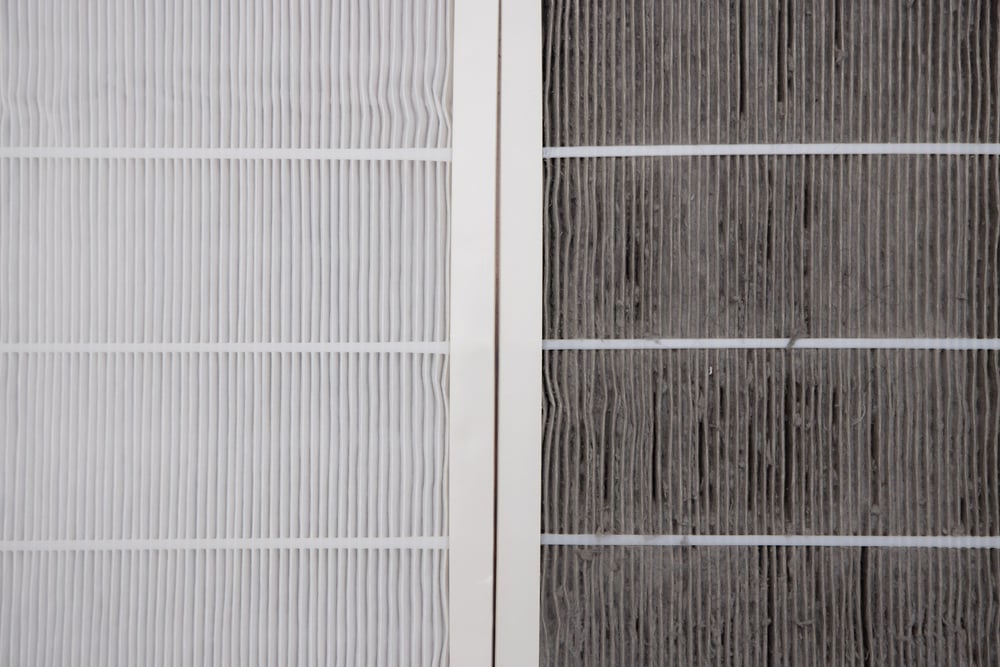
Mold spores generally measure between two and ten microns. That puts them comfortably within the range that quality mechanical filtration captures, which is the reason a well-specified filter is genuinely useful here rather than merely reassuring. The caveat is that a filter only cleans the air that physically passes through it. A portable unit in the living room does nothing for the bedroom down the hall, and a low-grade one-inch furnace filter, the kind sold in every hardware store on Highway 17, is designed mostly to protect the equipment rather than the people breathing around it.
There is also the odor question. Filtration catches particles, but the musty smell is not a particle. It comes from microbial volatile organic compounds, which are gases, and gases pass straight through a mechanical filter. That gap is precisely why air treatment technologies that work on the air itself, rather than only straining it, have become the more complete answer. We covered the mechanics of this in our comparison of bi-polar ionization and traditional air filters, and the short version is that the two approaches address different halves of the problem.
Treating the Whole House Rather Than One Room
The most effective setup in a Charleston home is one that treats air at the point where all of it converges, which is the HVAC system itself. Because your air handler already pulls from and pushes to every room, technology installed there works on the entire volume of air in the house continuously, including the air moving through the ductwork where spores like to travel. This is the principle behind the Matterhorn System, and it is why whole-home treatment consistently outperforms an assortment of portable units scattered around the house.
It also solves the coverage problem people rarely anticipate. Portable purifiers only work in occupied rooms with the doors closed, which is not how families actually live. A whole-home approach does not care whether the door is open or which room you happen to be standing in.
What to Do First, and in What Order
If you suspect mold in your home, the sequence matters. Find the water first. Almost every colony traces back to a specific moisture source, whether that is a slow supply line leak, a failed window seal, a crawlspace with poor vapor control, or simply a bathroom fan that was never ducted properly to the outside. Fix that, then remove the visible growth, then get indoor humidity under control so it stays between forty and fifty percent. Air purification comes after those steps, not instead of them.
Once that groundwork is done, though, continuous air treatment is what keeps the problem from quietly returning. Charleston does not stop being humid, pollen does not stop falling, and storms will keep pushing moisture into places it should not go. A house here needs an ongoing defense rather than a one-time cleanup.
A Realistic Expectation
Here is the promise worth making and the one worth avoiding. An air purifier will not remove mold from your shower grout, and any company that tells you otherwise is overselling. What it will do, if it is properly sized and installed where all of your air passes through it, is meaningfully reduce the spores circulating through your home, cut down the musty odor that comes with them, and make it far less likely that a small problem in one room becomes a recurring problem in five.
For most Lowcountry homeowners, that is exactly the right expectation, and it is a genuinely valuable one. If you would like to know what a whole-home approach would look like in your house specifically, our team is happy to walk through it with you. You can request a quote and we will take a look at your system, your square footage, and the particular quirks of your home before recommending anything.